









- Home
- Recent news
- Articles


[The Straits Times] From riches to rags to riches
The Straits Times, Singapore 07-03-2012
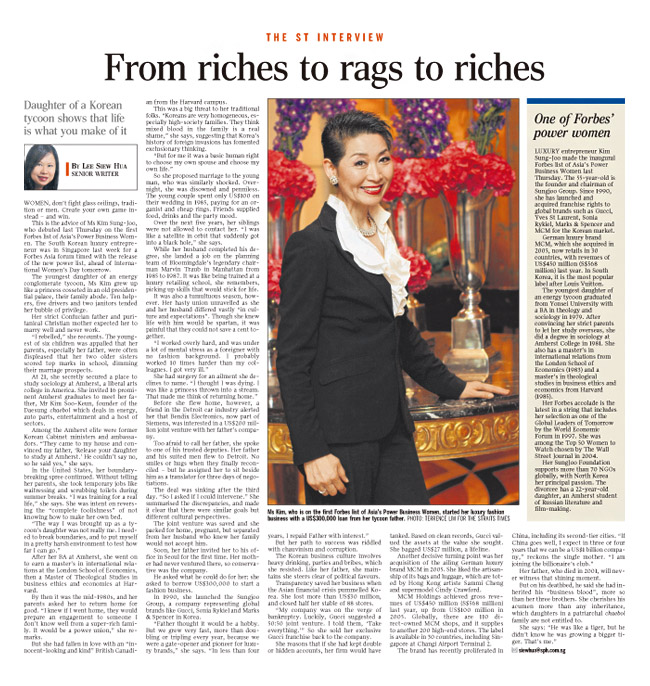
From riches to rags to riches
Daughter of a Korean tycoon shows that life is what you make of it
WOMEN, don’t fight glass ceilings, tradition or men. Create your own game instead ? and win.
This is the advice of Ms Kim Sung-Joo, who debuted last Thursday on the first Forbes list of Asia’s Power Business Women.
The South Korean luxury entrepreneur was in Singapore last week for a Forbes Asia forum timed with the release of the new power list, ahead of International Women’s Day tomorrow.
The youngest daughter of an energy conglomerate tycoon, Ms Kim grew up like a princess cosseted in an old presidential palace, their family abode. Ten helpers, five drivers and two janitors tended her bubble of privilege.
Her strict Confucian father and puritanical Christian mother expected her to marry well and never work.
“I rebelled,” she recounts. The youngest of six children was appalled that her parents, especially her father, were often displeased that her two older sisters scored top marks in school, dimming their marriage prospects.
At 21, she secretly secured a place to study sociology at Amherst, a liberal arts college in America. She invited 16 prominent Amherst graduates to meet her father, Mr Kim Soo-Keun, founder of the Daesung chaebol which deals in energy, auto parts, entertainment and a host of sectors.
Among the Amherst elite were former Korean Cabinet ministers and ambassadors.
“They came to my house and convinced my father, ‘Release your daughter to study at Amherst.’ He couldn’t say no, so he said yes,” she says. In the United States, her boundarybreaking spree continued. Without telling her parents, she took temporary jobs like waitressing and scrubbing toilets during summer breaks. “I was training for a real life,” she says. She was intent on reversing the “complete foolishness” of not knowing how to make her own bed.
“The way I was brought up as a tycoon’s daughter was not really me. I needed to break boundaries, and to put myself in a pretty harsh environment to test how far I can go.”
After her BA at Amherst, she went on to earn a master’s in international relations at the London School of Economics, then a Master of Theological Studies in business ethics and economics at Harvard.
By then it was the mid-1980s, and her parents asked her to return home for good. “I knew if I went home, they would prepare an engagement to someone I don’t know well from a super-rich family.
It would be a power union,” she remarks.
But she had fallen in love with an “innocent-looking and kind” British Canadian from the Harvard campus.
This was a big threat to her traditional folks. “Koreans are very homogeneous, especially high-society families. They think
mixed blood in the family is a real shame,” she says, suggesting that Korea’s history of foreign invasions has fomented
exclusionary thinking.
“But for me it was a basic human right to choose my own spouse and choose my own life.”
So she proposed marriage to the young man, who was similarly shocked. Overnight, she was disowned and penniless.
The young couple spent only US$100 on their wedding in 1985, paying for an organist and cheap rings. Friends supplied
food, drinks and the party mood.
Over the next five years, her siblings were not allowed to contact her. “I was like a satellite in orbit that suddenly got
into a black hole,” she says.
While her husband completed his degree, she landed a job on the planning team of Bloomingdale’s legendary chairman Marvin Traub in Manha


-
[Press Releases]
-
[Events]
Mrs. Sungjoo Kim Celebrates MCM's 50th Anniver...
















- Arab International Women's Forum
- Asia House
- Asian American Federation
- BPW International
- British Retail Consortium
- Cartier Women's Initiative Awards
- City Women's Network
- Cross Cultural Connection
- European Women´s Management Development International Network
- Frontier Awards
- FT Business of luxury Summit
- Global Economic Symposium
- Global Summit of Women
- Harvard Business School
- IFC World Bank
- "International Business&Leadership Symposium International Association
for Human Values" - Korean American Community Foundation (KACF)
- Keep A Chid Alive
- New York Asian Women's Center
- OECD
- Pan Asian Women's Association (PAWA)
- Prince's Trust
- The Red Mansion Foundation (RA of Arts)
- SEOUL INTERNATIONAL WOMEN'S ASSOCIATION (SIWA)
- The Committee of 200
- UN Global Compact
- Victoria & Albert Museum
- Women for Women
- Women Future 360
- Women in Law
- Women's Forum
- Women's International Networking
- Womens Leadership Board
- World Bank
- World Economic Forum